
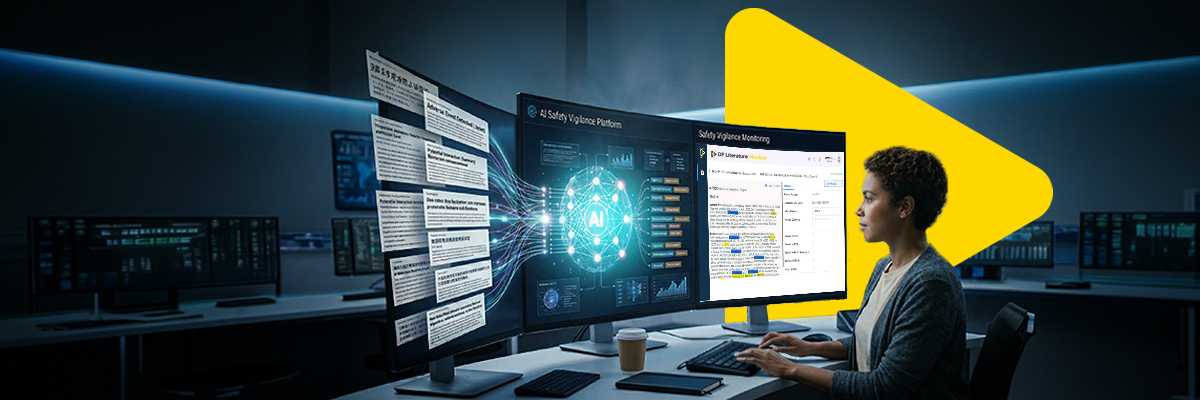
In today’s globalized life sciences landscape, multilingual literature monitoring for drug safety signals is both essential and increasingly challenging. While the volume and complexity of data are daunting, one of the most persistent obstacles for pharmacovigilance teams is language.
Critical safety information is often published in non-English journals or regional databases, and missing it can have serious consequences for patient safety and regulatory compliance.
The Language Barrier: More Than Just Words
Scientific literature is published in dozens of languages. While English remains dominant, a significant portion of critical safety information appears in non-English journals and regional databases. This linguistic diversity creates a major challenge: traditional literature monitoring relies heavily on the linguistic capabilities of the team, leaving non-English sources as potential blind spots.
But the challenge goes deeper than simply accessing or reading non-English articles. Scientific and medical writing is filled with specialized terminology, complex clinical context, and regulatory-specific phrasing. Automated translation often fails to capture the precise meaning of terms like “QT prolongation” or “dose-limiting toxicity,” increasing the risk of misinterpretation and incomplete safety assessments. Even minor translation errors can lead to serious consequences, such as misreporting adverse events or misclassifying drug reactions.
Real-World Cases: When Early Drug Safety Signals Were Lost in Translation
History shows that valuable safety information has often been missed due to language or regional publication barriers:
- Nimesulide (NSAID): widely prescribed in India, Italy, and Latin America, early reports of severe liver toxicity appeared in Indian and Italian journals in the late 1990s. Since the drug wasn’t marketed in the US or UK, these warnings were largely ignored. Years later, after dozens of fatal liver injury cases, the EMA restricted its use.
- Clozapine: fatal cases of agranulocytosis were first reported in local Finnish journals. The lack of international visibility delayed regulatory response. Only after widespread global incidents did authorities mandate blood monitoring programs for clozapine use.
- Kava (herbal medicine): early warnings of hepatotoxicity were in pacific island and German language journals. These were overlooked by global systems until reports escalated in Europe prompting the EMA and other regulators to restrict kava products.
- Topical Minoxidil: Initially deemed safe; reports of systemic absorption leading to cardiovascular events appeared in niche dermatology and cardiology journals. Because these reports were scattered and not widely cited, it took years before the FDA and dermatology societies added cardiovascular warnings.
Quality Management Challenges in Non-English Literature Monitoring
Even when literature is captured, quality issues often arise during the review and translation process:
- Inconsistent data quality: articles vary in structure and completeness, making standard safety data extraction difficult.
- Manual review dependency: teams often rely on human reviewers to translate and extract key data, which is slow and error prone.
- Multiple review layers: non-English content often passes through several people, increasing the risk of data degradation or misinterpretation.
- Regulatory compliance risks: misreporting due to misunderstood terminology can result in non-compliance, fines, or worse risk to patient safety.
Why Medical Translation in Pharmacovigilance Is Uniquely Complex
Translation in pharmacovigilance is not a simple matter of converting words from one language to another. It requires:
- Domain Expertise: Translators must understand medical, scientific, and regulatory terminology to ensure accuracy and context.
- Consistency Across Languages: Standardized terminology must be used to maintain data integrity and facilitate regulatory reporting.
- Data Security and Confidentiality: Patient data and safety reports are highly sensitive; any breach or error in translation can have legal and reputational consequences.
- Integration with Workflows: Translated data must seamlessly feed into existing pharmacovigilance systems, maintain audit trails, and ensure traceability.
How DF Literature Monitor Solves Multilingual Pharmacovigilance Monitoring?
Datafoundry’s DF Literature Monitor directly addresses these challenges with a suite of AI-powered features designed to automate and enhance literature monitoring for safety vigilance.
Automated Multilingual Support: DF Literature Monitor automatically translates abstracts and full-text articles into English, significantly reducing the language barrier and ensuring that non-English literature is no longer overlooked. If needed, the platform can route articles to authorized translation vendors for even greater accuracy, ensuring comprehensive coverage of global sources.
AI-Driven Data Extraction: The platform uses advanced Named Entity Recognition (NER) and Relationship Extraction (RE) models to identify and extract safety-related information, regardless of the article’s original language or format. This ensures that the minimum safety case information is captured quickly and accurately, without manual intervention.
Seamless Integration and Compliance: DF Literature Monitor integrates with over 25 global and local literature databases, enabling simultaneous import and review of articles from diverse sources. Automated de-duplication, entity tagging, and a robust QC workflow ensure that extracted data is high-quality, non-redundant, and regulatory-ready. The system supports export in E2B R2/R3 formats for seamless regulatory submission.
How DF Literature Monitor Delivers Measurable Results for PV Teams
With its automated translation and AI-powered extraction, DF Literature Monitor enables pharmacovigilance teams to monitor literature in multiple languages efficiently. This not only improves the completeness and accuracy of safety data but also reduces manual effort by up to 60%, delivering significant cost and time savings. Most importantly, it ensures that no safety signal is lost in translation: a critical advancement for patient safety and regulatory compliance.
In an era where scientific research has no linguistic boundaries, overcoming the language barrier is essential for effective literature monitoring. Datafoundry’s Literature Monitor sets a new standard by enabling truly global, multilingual surveillance, empowering both life science graduates and industry experts to safeguard patient health without compromise.
Ready to eliminate language blind spots in your safety monitoring? Explore DF Literature Monitor today.
FAQs
1. Why is monitoring non-English literature important for pharmacovigilance?
Critical safety information is often published in regional or non-English journals. Missing these reports can delay regulatory action, risk patient safety, and reduce the completeness of safety assessments. Cases like nimesulide, clozapine, and kava highlight how early signals were overlooked due to language barriers.
2. Can automated translation replace expert review?
Automated translation accelerates access to non-English literature but does not replace the need for domain expertise. Complex medical terminology, clinical context, and regulatory phrasing require review by professionals to ensure accuracy, context, and compliance.
3. How does DF Literature Monitor handle multiple languages?
DF Literature Monitor automatically translates abstracts and full-text articles into English. For higher accuracy or critical content, it can route articles to authorized translation vendors. This ensures comprehensive coverage across global sources without language blind spots.
4. What types of data can DF Literature Monitor extract?
The platform uses AI-driven Named Entity Recognition (NER) and Relationship Extraction (RE) to identify safety-relevant information, including:
- Adverse events and drug reactions
- Clinical trial outcomes
- Dose, route, and patient population details
- Relationships between drugs, conditions, and outcomes
5. How does the system ensure data quality and regulatory compliance?
DF Literature Monitor integrates robust quality control workflows, including:
- Automated de-duplication of articles
- Standardized terminology and entity tagging
- Audit trails and traceability
- Export in E2B R2/R3 formats for regulatory submission
6. Which databases does DF Literature Monitor support?
The platform integrates with over 25 global and regional literature databases, ensuring simultaneous access to both widely cited English journals and niche non-English sources.
7. How much manual effort can be reduced with DF Literature Monitor?
AI-powered translation and extraction can reduce manual literature review and data curation by up to 60%, freeing teams to focus on critical safety analysis and decision-making.
8. Is patient data secure during translation and extraction?
Yes. DF Literature Monitor adheres to strict data security and confidentiality standards, ensuring sensitive patient and clinical data are protected throughout translation, extraction, and workflow integration.
9. Who benefits most from using DF Literature Monitor?
- Pharmacovigilance teams monitoring global literature
- Regulatory affairs professionals preparing submissions
- Life sciences researchers seeking comprehensive safety insights
- Organizations aiming to reduce missed safety signals and improve efficiency
10. How does DF Literature Monitor help prevent “lost in translation” safety signals?
By combining automated multilingual access, AI-powered extraction, and compliance-ready workflows, the platform ensures that critical safety information from any language is captured, accurately interpreted, and integrated into global pharmacovigilance processes.
Author: Garvita Sharma