

Why Literature Monitoring is More
Complex Than Ever
Literature monitoring in pharmacovigilance sits at the heart of safety vigilance,
yet it remains one of the most complex processes to scale effectively.
Four challenges, in particular, are shaping how PV teams think about it today.

Article volumes are growing faster than teams can read
Thousands of new articles are indexed across PubMed, Embase, and other databases every week. Manual screening cannot keep pace, which means safety-relevant cases sit unreviewed, and reviewers spend unnecessary time on articles that turn out to be irrelevant.

Manual review still dominates the literature workflow
Most teams are still managing the process through a fragmented combination of database exports, spreadsheets, and shared inboxes. This fragmentation leads to duplicated efforts, data inconsistencies, and a thin audit trail that doesn't withstand regulatory scrutiny.

Regulatory timelines leave no room for missed cases
EMA and other authorities mandate specific search intervals and reporting timelines for adverse events found in literature. A single missed case can become a compliance issue, and proving that none were missed is harder than catching them in the first place.

Global, multilingual sources multiply the complexity
Safety signals don’t respect language boundaries. Teams need to cover local databases and non-English journals as carefully as the global ones, which is impractical without translation, named-entity recognition, and the workflow to triage at speed.
Datafoundry’s Literature Monitor - End-to-End
AI-Powered Literature Surveillance
Literature Monitor is Datafoundry’s purpose-built literature surveillance solution for pharmacovigilance teams. It automates the most time-intensive parts of the workflow, including multi-source article discovery, de-duplication, translation, safety information extraction, and case form generation, so your reviewers spend their time on clinical judgment, not on manual screening.
At its core, Literature Monitor combines semantic search across 25+ global and local literature databases with two NLP models developed in-house: a Named Entity Recognition (NER) model that identifies adverse events, conditions, and medications inside each article, and a Relationship Extraction (RE) model that links those entities together to generate Minimum Safety Information (MSI). The output is a structured, reviewer-ready Safety Case form, exportable in E2B and CIOMS format with a single click.
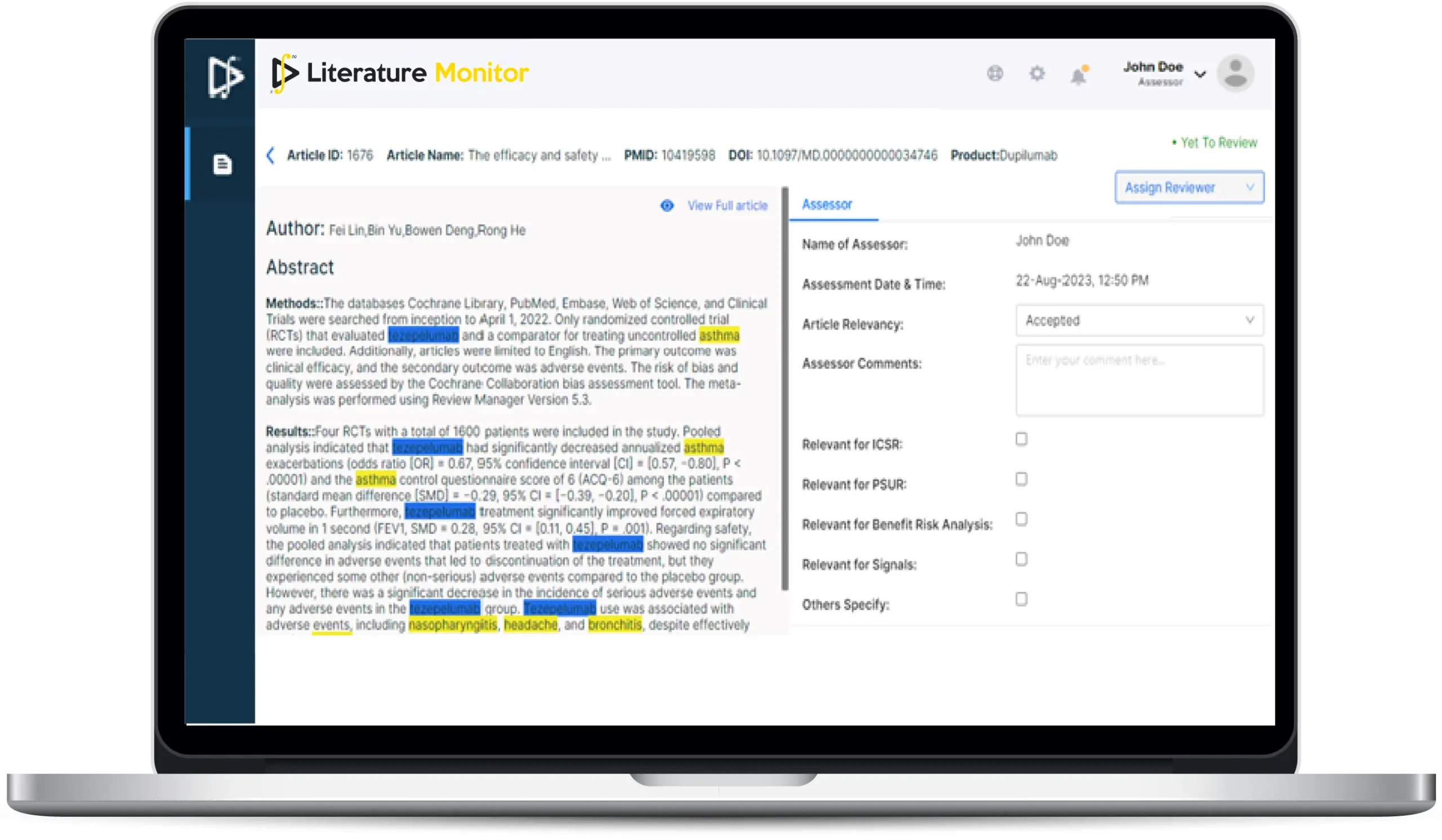
Literature Monitor is built to seamlessly integrate into your environment. Deploy it as a standalone solution or run it alongside Datafoundry’s Signal AI and Safety AI so you can modernize literature surveillance without disrupting the rest of your pharmacovigilance stack.
What Literature Monitor Helps You Do
A cloud-based literature monitoring solution that delivers speed, accuracy, and audit-ready compliance, grouped here by the outcomes that matter most to pharmacovigilance teams.

Find what matters, sooner. Literature Monitor runs scheduled semantic searches across more than 25 global and local databases in parallel, de-duplicates results at the source, and applies AI-powered relevance filtering, so your reviewers open a queue of safety-relevant articles, not a backlog of false positives.
- Automated multi-source ingestion across PubMed, Embase, Springer-Nature, and 20+ other databases
- Semantic search tuned to safety-relevance, not just keyword matching
- Automated de-duplication using a multi-pronged algorithm to eliminate duplicate entries
- Scheduled article searches aligned to your regulatory reporting cadence
Literature Monitor’s NLP models automate the most labor-intensive parts of the review process. NER scans each article for adverse events, conditions, and medications; RE links those entities together to extract Minimum Safety Information; and the system auto-populates a Safety Case form that’s ready for human review and one-click submission.
- Named Entity Recognition (NER) identifies adverse events, conditions, and medications
- Relationship Extraction (RE) links entities to generate Minimum Safety Information
- Auto-populated Safety Case forms that are reviewer-ready, with full source traceability
- Automated translation of abstracts and full articles into English


Literature Monitor is built around the regulatory frameworks that pharmacovigilance teams are already accountable to. EMA-aligned scheduling, 21 CFR Part 11 controls, and a complete audit trail are natively integrated, and the configurable workflow makes it easy to prove who saw what, when, and what they decided.
- EMA-aligned search scheduling to meet mandated reporting intervals
- 21 CFR Part 11 compliance for electronic records, signatures, and audit trail
- Configurable QC workflow with approve / reject decisions captured at every step
- Operational reports for audit, oversight, and management review
Literature Monitor was built to seamlessly integrate with your existing safety stack. Out-of-the-box connectors cover the literature sources and safety databases that pharmacovigilance teams cannot work without, and built-in translation supports surveillance across global markets, so the same system serves your headquarters, regional affiliates, and CRO partners.
- Connects with leading safety databases and signal management platforms, including Datafoundry’s Signal AI
- One-click submission in E2B and CIOMS format
- Centralized article repository with an article upload feature for product-level archives
- Multilingual coverage with automated translation for non-English sources

A user-friendly interface, an end-to-end workflow, and a system architected for regulated pharmacovigilance from the ground up.
Reduce Your Literature Monitoring Effort by up to

Improved productivity and accuracy
Automated ingestion, de-duplication, and NLP-driven extraction cut up to 60% of the time and effort your team spends on literature surveillance.

Drop-in deployment
Run Literature Monitor on its own or connect it to your existing safety database and signal management system to modernize the workflow without re-platforming the rest of your PV stack.

Regulated-grade by design
Built to meet applicable regulations and guidance, including 21 CFR Part 11, data integrity and privacy controls, and GxP with the audit trail to prove it.

Built for the people who use it
A configurable workflow shaped by inputs from pharmacovigilance domain experts, ensuring that collaboration, QC, and approvals all live inside the system, not across email threads.
How Literature Monitor Works
A six-step workflow that takes your team from a raw search across global databases to a regulator-ready Safety Case form, with most teams up and running on Literature Monitor within four to six weeks of kick-off.
Further Reading on Literature Monitoring
A curated set of perspectives from the Datafoundry team on where AI-powered literature monitoring is heading — and what it means for pharmacovigilance.

Frequently Asked Questions
